Showing posts sorted by relevance for query cabin fever. Sort by date Show all posts

Cabin Fever, X

Cabin Fever
Two horror films I caught recently led me to muse on the strains of American Gothic that have persisted in our cultural landscape. The two prime inventors of the American Gothic template are two decadent Romantics, Poe and Hawthorne. Poe's influence on the horror film is too obvious to be belabored, but I want to stress that Poe's literary and cultural models were European. Many of Poe's famous stories are set in a real or imagined Europe (The Murders in the Rue Morgue, The Cask of Amontillado, The Pit and the Pendulum) Hawthorne's Gothic legacy is almost wholly focused on his disgust with his Puritan forebears. Since the 19th century, writers from a variety of regions in the US have utilized the Gothic genre to express a dark ambivalence towards their homeland: Faulkner, O'Connor, Shirley Jackson, Stephen King, S. Craig Zahler. Hawthorne's influence on the American horror film has been less prevalent than Poe's, but it still survives. Josephine Decker's Shirley certainly takes some of its cues from Hawthorne's forays into the forest in The Scarlet Letter.

Most American films before 1968 take a sunny view of rural Americana. John Ford's films with Will Rogers are a good example. However, there are exceptions. The Story of Temple Drake, an adaptation of Faulkner's Sanctuary, caused a furor in 1933. The film is dreck, but the subject matter is tawdry enough that it could be made today as an exploitation film. Other, better films with elements of rural Gothic Americana (such as Frank Borzage's Moonrise in 1948 and Charles Laughton's The Night of the Hunter, Psycho, etc.) reflect the rise of socially conscious films following the Second World War. America was more fully ready to face its dark side after the unspeakable horror of global conflict.  George Romero's The Night of the Living Dead, from 1968, signaled a further shift. Horror film's became a venue to express the counterculture's disgust with mainstream America. Films like Tobe Hooper's The Texas Chainsaw Massacre and Wes Craven's The Hills Have Eyes express a disquietude with a mutated primeval horror emanating from America's heartland. Other examples include Eaten Alive, Motel Hell, and even Deliverance. 

Eli Roth's Cabin Fever, from 2002, mixes several subgenres including American Gothic. The premise is that a group of comely recent college graduates shack up in a rural cabin and sinister events unfold. The obvious template is Sam Raimi's The Evil Dead. Roth, in his directorial debut, even mimics Raimi's Steadicam shots whooshing through the forest. A mysterious toxin has infiltrated the local water leading to vomiting of blood, peeling of skin, and general body horror. The film, thus, shows it debts to the ecological horror of such films as Romero's The Crazies and The Toxic Avenger. The locals in Cabin Fever are uniformly distrustful, ignorant, and violent. One of the interlopers is greeted in the local burg with a bite on the arm by a seemingly rabid youngster.

I'm no fan of Roth's subsequent career, but Cabin Fever show promise. The camera set-ups are exactly judged and the cast of relative unknowns is well handled. The most stupid and macho of the grads is, presciently,  a proto MAGA figure, baseball cap and all. The film was received negatively for its mix of humor and horror, but I think the yuks are its saving grace. It is a pity that Mr. Roth's subsequent and more successful films seem to end up in torture chambers, but, then, I haven't seen 2018's The House with a Clock in Its Walls

Mia Goth in X

Ti West's recent X is a slightly better film with a slightly bigger budget. Mr. West had access to a crane and demonstrates he knows how to use it. An adult film crew rents a cottage on a rural property in 1979 and are soon besieged by the gothic couple who have resided there for decades; and their antsy gator. The body horror, juxtaposed with the nubile flesh of the porn stars, is more palpable than in Cabin Fever. The ancient couple seems to be decomposing before our eyes. X is a film geared to horror aficionados who can cite its antecedents rather than the general audience, but it represents a step forward for Mr. West. He has toiled making genre films, mostly horror, for over a decade and seems to have honed his sense of craft.

He is greatly helped by his lead, Mia Goth, who plays both one of the porn stars and a mad crone who has issues with physical decomposition. The roles allow her to show the full range of her talents. A woman who has worked with Lars von Trier and been married to Shia LaBeouf deserves our sympathy and consideration. While not a film I would recommend to strangers (or you Mom) , X resounded enough for horror fans to have spawned both a prequel, current release Pearl, and an upcoming sequel, MaXXXine

Best of 2002


  1. Talk to Her                                                                     Pedro Almodóvar
  2. Adaptation                                                                     Spike Jonze
  3. Infernal Affairs                                                              Andrew Lau and Alan Mak
  4. Unknown Pleasures                                                      Jia Zhangke
  5. Gangs of New York                                                        Martin Scorsese
  6. Dracula: Pages from a Virgin's Diary                          Guy Maddin
  7. Morvern Callar                                                               Lynne Ramsay
  8. The Good Girl                                                                Miguel Arteta
  9. La Commune (Paris, 1871)                                            Peter Watkins
  10. Frida                                                                                Julie Taymor
      Honorable Mention

      Painted Fire -- Im, 25th Hour-- Lee, Springtime in a Small Town -- Tian,
      Igby Goes Down -- Steers, Spider Man --Raimi, 
      Japon -- Reygadas, Laurel Canyon -- Cholodenko,
      Catch Me If You Can -- Spielberg,


     Movies I Enjoyed

      City of God, Irreversible,
      Distant, Hukkle,
      8 Women, In America, 
      Sympathy for Lady Vengeance, Secretary,
     28 Days Later, Orange County, Gerry,
     Punch Drunk Love, The Man Without a Past,
     The Cat's Meow, Minority Report, 
     Heaven, The Pianist,
     Phone Booth, Panic Room,
     24 Hour Party People, Hero, 
     The Lord of the Rings: The Two Towers, Russian Ark,
     The Piano Teacher, Spider, 
     Lilya 4 Ever, Roger Dodger,
     Dark Water, 
     Femme Fatale, About Schmidt,
     Star Wars: Attack of the Clones, Big Fat Liar, 
     Chicago, The Count of Monte Cristo


     Below the Mendoza Line

     Far From Heaven, May,
     Interstate 60, No Such Thing,
     The Transporter, The Hot Chick,
     Ju-on: The Grudge, My Big Fat Greek Wedding,
     Red Dragon, One Hour Photo, 
     Unfaithful, The Bourne Identity, 
     Signs, Jackass, 
     Murder by Numbers, The Ring, 
     Road to Perdition, Ice Age, 
     Die Another Day, Eight Legged Freaks,
     The Rules of Attraction, Rabbit Proof Fence,
     Cabin Fever,
     The Hours, Austin Powers in Goldmember, 
     Ali G Indahouse, Sweet Home Alabama,
     Harry Potter and the Chamber of Secrets, XXX,
     Scooby Doo, Resident Evil,
     Killing Me Softly,
     Van Wilder, Reign of Fire
                                                     

Thanksgiving

               
Eli Roth's Thanksgiving received a better than average critical reception for a horror film, but sank at the box office. I found it rather tiresome. It reenforced my feeling that Roth sits, at best, amongst the second rank of American horror genre specialists. The plot, concocted by Roth and Jeff Rendell, is a repackaging of Scream. We have a clutch of fresh faced 'high school' thesps terrorized by a masked mystery man. Once again, the police seem hapless and the local television station helps spark a media frenzy. Everything seems second hand. especially the "John Carver" Pilgrim mask of the villain that is a homogenized variant of the "Guy Fawkes" mask worn by Hugo Weaving in V for Vendetta.

Not that Roth wants Thanksgiving to be bland fare. The killings are gruesome and the first act group trauma aims to say something about our country or something. A stampede at a Black Friday sale at a Best Buy-Wal-Mart- type store is based on a clutch of such events, but is so cartoonishly overdone, "Free Waffle Irons" is the giveaway. that, subsequently,  the film only retains a smidge of interest when indulging in black comic killings that revel in decapitations and intestines resembling blutwurst. Roth's cast is not as memorable as in the Craven films and this is fatal. We have no sympathy for or empathy with the intended victims and, thus, no suspense is generated. Everything, even the murders, seems rote. 

The film is not helped by its lack of local flavor. Supposedly set in Plymouth, Massachusetts, but shot in Canada, the film evokes poutine instead of chowder. There are a few attempts at a regional accent, but as usual with Roth, the cast is left to its own devices and stranded amidst a meaningless mise-en-scene. Roth is fine with framing shots and constructing sequences, but, from Cabin Fever on has proved clueless when it comes to enlivening his casts. If you can't establish heroes or villains inside your set-ups, the audience will not be able to enjoy your cinematic thrill ride much less swallow indigestible thematic material. Whatever his artistic or thematic intentions, Roth has not made a satisfying film, just mechanical simulacrum of better ones. I respect his knowledge and love of horror films, but find his work wanting. 

Mandy

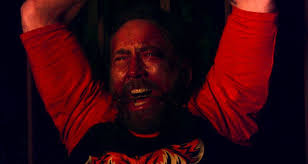
Nicholas Cage goes gonzo again in Mandy

Panos Cosmatos' Mandy is a whacked out fever dream of a movie. This pulp piece superbly integrates lysergic cinematography, sound and art design, Even the bespoke paperback covers, songs and commercials display wit and ingenuity. Ostensibly, a spam in a cabin exploitation flick with Nicholas Cage and Andrea Riseborough, Cosmatos' film explores how the influence of the counterculture persisted into the Reagan era. I'm not sure Cosmatos is enough of a thinker to fully realize the implications of his themes, but Mandy overflows with visual imagination. 

Nicholas Cage does his usual gonzo act, as he spends the second half of the film wreaking vengeance upon a religious cult that tortured and killed his life partner. For once, after effluvia like Rage, Bangkok Dangerous and many. many more, Cage has a proper context for his howls and cries. This is not to downplay the strength of his performance or his commitment. Cosmatos wisely spends a very deliberate first third of the picture establishing Cage and Riseborough's relationship. This makes the ensuing carnage somewhat earned.

Riseborough is one of the most accomplished actors of her generation. She delivers the film's finest monologue, but is best utilized here simply gazing at the camera. Linus Roache gets to chew the scenery as a cult leader and delivers his most memorable performance since The Wings of the Dove. Yet, the performances are secondary to the manic visual splendor of Mandy. A film that alternately celebrates and critiques acid culture, as it immerses the viewer in it. (12/9/18)