House of Gucci


Ridley Scott's House of Gucci filled me with ambivalence and not in a good way. He is a superb producer, stars flock to work in his luxe concoctions. He shoots films in an objective and commercial style that can turn good scripts into such superior films as Alien, Thelma and Louise, and The Counselor. Otherwise, his impersonal style fails to uplift middling material and House of Gucci is a subprime example. 

I won't go into the machinations of the Gucci clan that fill the two and a half hour run time. The film is at least a half an hour too long. It doesn't lumber, but no spark is lit. Lady Gaga and Adam Driver are well cast as a mismatched couple. Gaga provides the guttersnipe feistiness of a social climber and Driver can certainly do tall and awkward.👾 The rest of the cast is more than adequate, though Jared Leto seems to be in another movie, maybe a Super Mario Brothers reboot. However, a movie about the fashion industry needs a little campy outrageousness and Scott's anonymous craftmanship has none of that.

The film's attempts at humor, not Scott's forte, flounder. A raucous rugby game that introduces Leto's character is badly bungled. The disco and opera numbers on the soundtrack are tres obvious, tunes that have been done to death. House of Gucci, despite the obvious care of the production, is unfocused. Not really a melodrama, a true crime yarn or a chronicle of the fashion biz. Not really much of anything.

👾A number of people I am close to have mentioned how much they dislike Adam Driver. People, he can't help his looks! I find him a supple and versatile actor. He would make an interesting Lincoln.

Paterson


I savored Jim Jarmusch's Paterson like a nice sorbet, but found it a bit slight. It is more a meditation on the poetry to be found in everyday existence than a traditional narrative film. We follow Adam Driver as the titular character, a poetry writing bus driver in New Jersey, as he goes about his daily routine. He drives his bus, walks his dog, canoodles with his wife and chats with his friends at a bar. There are a few incidents, but, on the whole, not much happens to our hero. What is Jarmusch's locus of concern are the poetic reveries contained in the seemingly mundane details of life that spark the poet's imagination.

Jarmusch's collaborators are instrumental in bringing forth this theme: the cast is winning, Frederick Elmes' cinematography is subtly beautiful, and the costume and set design are just so. If there is a fault in Jarmusch's schema it is that the character of the wife and her endeavors are overly precious. Also, Jarmusch is self indulgent in picturing his obsessions. There is a wall of heroes in the bar, much like the one in Only Lovers Left Alive, that a black bartender adds a picture of Iggy Pop, subject of a recent Jarmusch documentary, to. A bit of a stretch, I think.

The theme of doubling seems a bit tacked on. Paterson the character lives in Paterson the town, home to the poet William Carlos Williams whose work is echoed by the poems Ron Padgett provides to the film. There are at least three sets of twins pictured during the course of the film. Jarmusch, as earlier in his career, flirts with cutesy knowingness. That said, I found the contemplative quality of Paterson to be a balm to the soul in a cinematic landscape littered with CGI carnage. (4/14/17)

Une Femme Douce

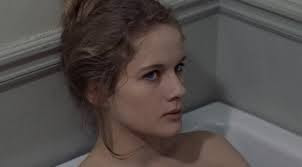
Dominique Sanda in Une Femme Douce
Robert Bresson's Une Femme Douce, from 1969 is an astringent amalgam of Bresson's and Dostoyevsky's sensibilities. Despite their stylistic differences, there is a shared moral concern between the two. In Dostoyevsky's A Gentle Creature, the source of Une Femme Douce, the spiritual stagnation (kosnost) of the narrator drives his wife to suicide. The narrator in both versions is a pawnbroker who castigates his young bride when he thinks she is being overly generous in settling with clients. 

Dominique Sanda, in her film debut, plays the young woman, named Elle. She marries in haste, a union that brings both partners torment; as in a good number of the love pairings in the curdled and crazed oeuvre of the Russian master. Une Femme Douce marks a shift in Bresson's work. This is his first color film and the first of his films in which any hope of escape from one's confines, be they material or spiritual, is refuted. Cages and containers are a constant motif in the film, most obviously in the visits to the zoo and natural history museum. Bresson shares Dostoyevsky's abhorrence of modern spiritual stagnation. The opening sequence in the pawnshop, with numerous closeups of hands exchanging trinkets for cash, establishes the capitalistic France of 1968 as a transactional culture. Christian values of love and charity, which Elle seeks to emulate, are in short supply. Bresson would continue pursuing this condemnation of usury, most forcefully in his ultimate film, L'Argent.   

In an indelible debut, Ms. Sanda is otherworldly. As her husband, Guy Frangin is appropriately chilly and repellent. This is his only film credit, testimony to Bresson's desire to work with non-professionals. This strategy yielded some of the most indelible and non-actorly performances in the cinema, but it is off-putting to a lot of viewers. Nevertheless, Une Femme Douce, which jettisons some supporting characters from the original story, is a succinct and discordant masterpiece.