Two Claudette Colbert Features: Three-Cornered Moon and Maid of Salem

Claudette Colbert in Three Cornered Moon
Elliott Nugent's Three Cornered Moon, from 1933, is a successful opening up of Gertrude Friedberg's play, a good early example of screwball comedy. As in most screwball comedies, there is overlapping dialogue, physical schtick, and a wacky and wealthy family. Mary Boland plays the ditzy matriarch of an antic clan, three immature adult brothers and a sis played by Ms. Colbert, who live in a mansion in Brooklyn. The brothers roar around the house engaging in hijinks while Colbert ponders the romantic advances of a starving artist and a stable doctor. After the first reel, the family learns that they are destitute and must now labor for their bread and board like the rest of a US locked in the Depression.

Each of the three brothers struggles with employment while Colbert suffers from sexual harassment. Eventually barriers are overcome, inhibitions are discarded, and true love emerges triumphant. The male actors, including Richard Arlen and Wallace Ford, are forgettable, but the distaff half shines. Boland plays an idiot charmingly and Colbert really swims in this kind of fare. Nugent always displays a good sense of pacing and blocking with his players, but there is a rare friskiness to his direction here, particularly in his use of sight gags. The film's sexual politics and Polish jokes have dated, but I found the film to be a tonic. It unspools in 77 minutes.
             
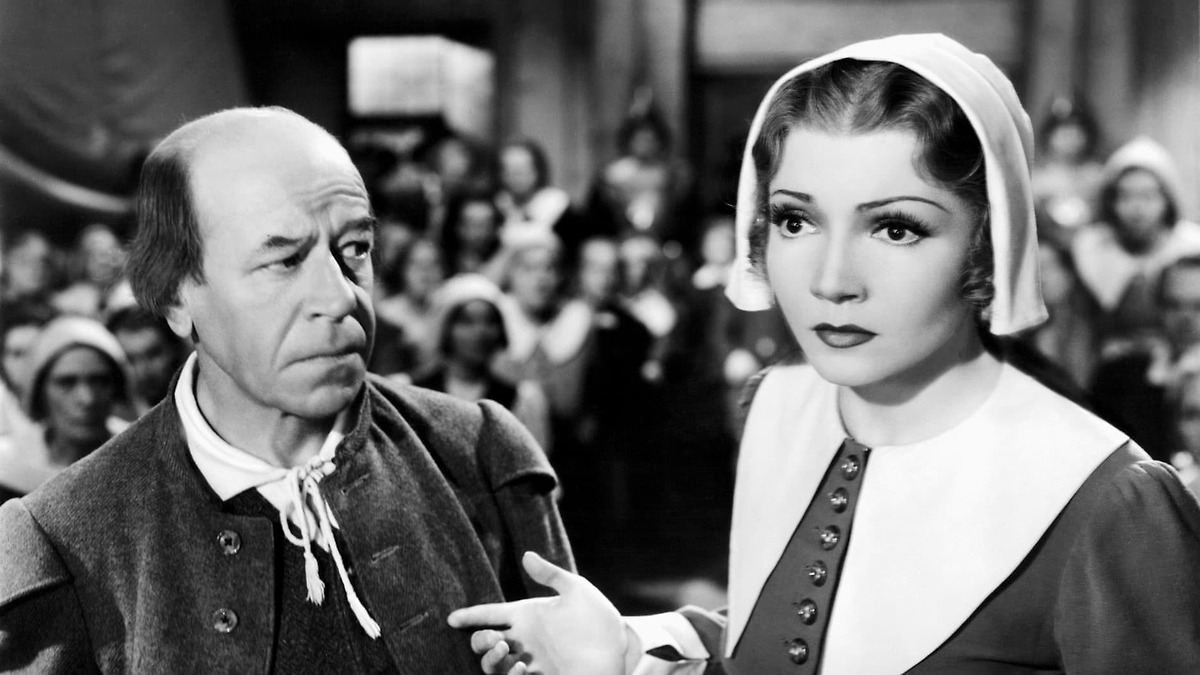
Donald Meek and Colbert in Maid of Salem
Unlike the charming Three Cornered Moon, Frank Lloyd's Maid of Satan is dire. This 1937 version of the Salem witch trials changes the names of all involved (except Tituba) to protect the guilty, out of kindness I suppose. We know that Colbert's character will be fingered because she loves frippery, dancing, and Virginia cavalier Fred McMurray. As with the later Drums Along the Mohawk, Colbert is not entirely at ease in a period role. The only time she gets to show off her apple cheeked charm is a scene of her practicing the gavotte. McMurray is even more at sea in a role that seems more based on Errol Flynn than any historic character. Bonita Granville effectively reprises her These Three role as Maid in Salem's number one fink. The direction is leaden. One reason to see the film is a choice roster of supporting players: Sterling Holloway, Russell Simpson, Donald Meek, Gale Sondergaard, Beulah Bondi, J. Farrell MacDonald, William Farnum, Donald Meek (a perfectly cast Puritan), and, as Tituba, the legendary Madame Sul-Te-Wan. I also enjoyed Victor Young's score, but the verdict is... beware. 


Heretic

Hugh Grant

Scott Beck and Bryan Woods' Heretic is a slightly above average horror flick. The film's initial premise is intriguing, but the film soon degenerates into more standard fare. Two Mormon missionaries (Sophie Thatcher and Chloe East) are invited into the house of an older man who initially seems charming, but soon proves to be throughly sinister. This character, in an inspired bit of casting, is played by Hugh Grant who has always been a fount of surface charm. Grant's character has an axe to grind against organized religion and Mr. Woods and Mr. Beck's script provides him with witty rants that are one part pop culture and one part The Golden Bough. Mr. Grant is up to the challenge and eschews vanity to finally look his age, in stark contrast to the very young damsels in distress.     

Ms. East and Ms. Thatcher are also both quite effective. I rate Ms. Thatcher, so good in Yellowjackets, to be a real comer. Her fierceness reminds me of the young Nicola Pagett. Unfortunately, by the time the two young women discover the nastiness in Mr. Grant's basement, the film peters out into a routine thriller. It is too late to count them out, but it seems that Mr. Beck and Mr. Woods' talents lay more in script writing than direction. With a few exceptions, the images in Heretic tend to evaporate in one's mind's eye rather stick. The climax of Heretic, thus, seems more pro forma than terrifying.   

Yella

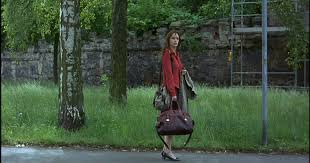
Nina Hass in transit
Christian Petzold's Yella, from 2007, is a knotty German thriller that established Petzold as one of the leading directors of this century. Nina Hass plays Yella, a young woman who we soon learn is attempting to leave her marriage. However, the husband, named Ben (Hinnerk Schönemann), refuses to accept this and spends the film stalking, badgering, and abusing Yella. He even drives his car off a bridge rather than drive Yella to the train station. Yella leaves her home town of Wittenberg to accept a job in Hanover, moving from the former East Germany to the more prosperous west. That job turns out to be a mirage, all her crooked boss wants is some slap and tickle. However, she runs into a cocksure business man named Phillip (Devid Striesow) at her hotel's restaurant. Phillip, who susses Yella's accounting skills, invites her to be his number cruncher at a business meeting the next day and a new stage in Yella's life has begun. 

It turns out Phillip is a liaison for a shady financier who loans out money, at exorbitant rates, to capitalists who cannot get bank loans. Yella takes to her new life well and even starts falling for Phillip. However, she eventually grasps that Phillip is stealing from his boss and is heading for a fall. The vision of capitalism is that of the art of the scam, everyone is on the make. Yella concludes with a fatalistic ending that has been previously foretold. Throughout the film, Petzold weaves themes (transit, surveillance) and imagery (especially that of water) that would recur throughout his later work. If you enjoy Yella, I strongly urge you to seek out Petzold's later masterpieces with Nina Hass, Barbara and Phoenix, both of which contain sublime acting and filmmaking.

Spoiler Alert

I cannot fully grapple with Yella without spilling the beans about the ending. Earlier in the film, when Ben drives the car containing he and Yella off a bridge and into a river, both passengers survive the plunge and collapse on the river bank. Somewhat improbably, Yella is able to retrieve her bags and make her train to Hanover. The film continues with her further misadventure until the accident is repeated at the end of the film. This time Yella and Ben are dead, their bodies covered by rescue workers. One interpretation I'll offer is that Petzold is offering us a variation of Ambrose Bierce's An Occurrence at Owl Creek Bridge in which the narrator imagines an escape and homecoming in the few moments before he dies from a hanging. It would explain the weird migraines and or psychotic breaks Yella experiences, always accompanied by liquid imagery, where she hears a high pitched sound and water rushing.