Caravaggio, Face to Face

Poses and folds in Caravaggio
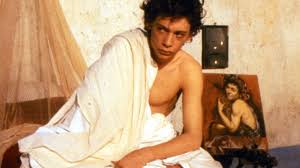
Derek Jarman's Caravaggio, from 1986, is a meditation on the artist and his work. It is not a narrative bio-pic, but it is, if accepted on its own terms, a fitfully arresting art film. A series of vignettes unfold in flashback after we meet the dying Caravaggio being attended by his mute servant. The plot is a fanciful, bare-bones rendering of the tortured artist's life: he finds a patron in Cardinal Del Monte, portrayed by Michael Gough, but gets caught up in a tragic love triangle with Tilda Swinton and Sean Bean. The plot, while not entirely historically accurate, does show how the artist mingled with both high and low society, often using rent boys and girls as models. Most of the film has Caravaggio dashing off a masterpiece while his companions pose and party on.

I am a big Caravaggio fan and have read more about his life and work than is perhaps recommendable. I may be harder to please than most regarding works about the master. I wholeheartedly recommend two books concerning Caravaggio: Peter Robb's half biographical, half speculative M: The Man Who Became Caravaggio and Alvaro Enrigue's phantasmagoric novel Sudden Death. Both are superb. Jarman's conception of the artist doesn't jibe with mine. Nigel Terry is a fine and sensitive actor, but he is too fine and sensitive to play Caravaggio. Caravaggio was a lout, forever getting into drunken scrapes. A young Oliver Reed would have been ideal casting. Jarman pictures Caravaggio as a champion of the downtrodden and there is truth to this notion. However, I think Jarman errs by eliding aspects of Caravaggio's personality. He is portrayed generously taking a mute out of charity as his assistant.  Their relationship is sweet, but that is the problem with the film: its Caravaggio is more sweet than transgressive. Caravaggio's actual model and companion, Cecco (aka Francesco Boneri, aka Cecco del Caravaggio), is most vividly displayed in Caravaggio's own Amor Vincit Omnia. The element of pederasty might have been too transgressive for Jarman to tackle.

Sandy Powell's costumes are splendid, as is Simon Fisher-Turner's music. Jarman was reacting against the bombastic Hollywood soundtracks of the day, wanting to create "an area of silence amid the hubbub of modern entertainment." Here, and especially in Blue, he succeeded. Sean Bean and Tilda Swinton are also assets to the film. Swinton has an especially nice moment as a hardened whore driven to rapture by being able to wear an expensive frock. She would never look as joyous and youthful again. Still, Jarman's awkwardness in his handling of group scenes, when his actors are not posing on their marks, marks him as a minor director. This was driven home to me watching Face to Face, Ingmar Bergman's 1976 effort. Bergman's tableaus are every bit as artificial as Jarman's, but, because of his dramatic and cinematic rigor, they throb with lived in intensity. When Erland Josephson comforts Liv Ullmann in bed, the sheets and blankets create intense folds that highlight the intimacy of a scene, like a Pieta. Jarman, aping Caravaggio's baroque detail, uses fabric similarly, but the effect is self-conscious and superficial.

This is not to say that Face to Face is a flawless masterpiece, but it is one of the better films he made after the spasmodic breakthrough of Persona in 1966. Bergman could never do mod, so a gay party scene early on falls flat. The intensity of Ullman's performance transcends any clunky moments. Portraying a woman losing her grip on sanity as dark visions erupt from her unconscious, Ullmann is scarifying in her vulnerability. An abortive rape hurtles her into a downward spiral that resonates even more today in a world rife with PTSD.   This is Ullmann best performance because it is her least vain and self-aggrandizing one. When her character, recovering from a suicide attempt, is chided by her daughter for her insensitivity, Ullmann's ruefully acceptant reaction not only embodies her character's masochism, but underlines Bergman's notion of family dynamics as an endless cycle of abuse and recrimination.

If anything, I find Bergman's "happy" ending to be too pat. Ullmann's character recovers far too easily from her malady after a dubiously cathartic session. Nevertheless, there is much to appreciate here. Most of Face to Face is filmed in two shots with a fixed camera. Pans are used to evoke the mental decomposition of Ullmann's character, most memorably a POV shot of Ullmann's room as she slips into unconsciousness; which Woody Allen echoed in Interiors. Face to Face could very well have been entitled Interiors. There are a few establishing exterior shots, but the majority of the film is indoors. Evan the expanse of Ullmann's unconscious seems cramped in Face to Face.


Cramped quarters in Face to Face

Best of 1990

  1. GoodFellas                                                                          Martin Scorsese
  2. Miller's Crossing                                                                 Joel and Ethan Cohen
  3. Metropolitan                                                                        Whit Stillman
  4. Texasville                                                                             Peter Bogdanovich
  5. Europa, Europa                                                                   Agnieszka Holland
  6. King of New York                                                                Abel Ferrara
  7. Ju Dou                                                                                 Zhang Yimou
  8. La désenchantée                                                                 Benoit Jacquot
  9. The Hot Spot                                                                       Dennis Hopper
  10. Edward Scissorhands                                                        Tim Burton
         Honorable Mention

         Cyrano de Bergerac -- Rappeneau, The Match Factory Girl -- Kaurismaki,
         To Sleep with Anger -- Burnett, White Hunter, Black Heart -- Eastwood

         Films I Enjoyed

         Darkman, After Dark My Sweet, 
         Miami Blues, Cry Baby, 
         The Freshman, Total Recall,
         Bad Influence, Internal Affairs, 
         Tune in Tomorrow, The Comfort of Strangers,
         An Angel at My Table, Tie Me Up! Tie Me Down!, Days of Being Wild, 
         Men Don't Leave, Quick Change, 
         Pretty Woman, Tremors, Russia House, 
         The Godfather 3, Young Guns 2, Presumed Innocent, 
         Wild at Heart, The Witches, 
         The Grifters, Pump Up the Volume, 
         Dreams,  Reversal of Fortune, 
         Henry and June, Archangel, 
         The Cook, The Thief, His Wife & Her Lover, Close Up,
         Frankenhooker, Postcards From the Edge, 
        Misery, Joe Versus the Volcano

         Under the Mendoza Line

         Mountains of the Moon, Quigley Down Under,
         The Sheltering Sky, Mo' Better Blues,
         Korczak, The Voice of the Moon,
         I Love You to Death, I'm Dangerous Tonight,
         Air America, Back to the Future 3,  
         The Hunt for Red October, Child's Play 2,
         Pacific Heights, Gremlins 2, 
         The Exorcist 3, Robocop 2,
         Tales from the Darkside: The Movie,
         Rosencrantz and Guildenstern are Dead
         Nightbreed, Kindergarten Cop,
         Another 48 Hours, Die Hard 2, 
        Awakenings, Baby Blood,
        Jacob's Ladder, Arachnophobia,
         The Reflecting Skin, Flatliners, 
         Dances With Wolves, Home Alone,
         Ghost, Dick Tracy, 
         Days of Thunder, The Bonfire of the Vanities


Living on Velvet

Kay Francis gets down with her bad self (and Warren William) in Living on Velvet

Frank Borzage's Living on Velvet, from 1935, is an entertaining mishmash: part aviation flick, part love triangle and all Borzage in its dedication to the travails of romantic love. George Brent stars as a flyboy recovering from the trauma of accidentally killing his Ma, Pa and Sis in a plane crash. He wanders the world trying to forget, but things change when he attends a swank gathering at his best bud's (Warren William) penthouse. There he meets Williams' girlfriend, Kay Francis. Sparks fly and soon he and Francis are living on velvet.

The first half of the flick is prime Borzage. The plane crash is well handled, reminiscent of History is Made at Night in its balancing of suspenseful action and character vignettes. The penthouse party is illustrated with graceful pans: Borzage fully at home within the milieu. Brent and Francis share a charming coffee house scene with a counterman, the omnipresent Edgar Kennedy, eager to ditch the late night lovebirds.

Once the twosome are hitched and domestic problems arise, Living on Velvet loses momentum. Nobody wants to see the glamorous Miss Francis reduced to domestic drudgery. Virtually forgotten today, Francis is perfect for romantic fare like this and gets to strut her stuff in some magnificent Orry Kelly outfits. My knees were certainly knocking at the backless number she wore. Borzage was a sensitive director of actors and could even breathe warmth into a cold technician like Helen Hayes. Warren William and George Brent give enjoyable performances here. The stiff Brent is unusually animated. Living on Velvet is slight fare lifted above the ordinary by the Borzage touch.