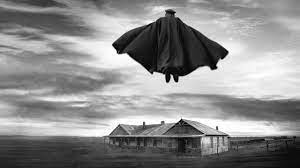
El Conde

              
Pablo Larrain's El Conde (The Count) is a satiric horror film that portrays Chilean dictator Augusto Pinochet as a vampire who has lost his lust for life. Pinochet's children, who are eager to seize their inheritance, hire a nun named Carmen to hasten his demise. Under the guise of auditing his estate, Carmen travels to the bleak rural farm where Pinochet is hiding in order to dispatch the ex-dictator. Plans, however, go awry.

The opening twenty minutes of the film, which traces Pinochet's genesis back to the French Revolution, is the most entertaining segment in any Larrain film, but things bog down when Carmen arrives at the farm. In her guise as an auditor, Carmen interviews Pinochet and his family about their holdings. This enables Larrain, to soporific effect, an opportunity to review Pinochet's many crimes, including widespread slaughter of his political opponents and the looting of national assets to his family's benefit. Margaret Thatcher shows up as Pinochet's vampire mother because Larrain wants to link Pinochet's fascist government with the right wing democratic leaders who helped prop up his regime. Stella Gonet, who portrayed Queen Elizabeth II in Larrain's Spencer and has portrayed the former PM on stage, plays Thatcher and drolly handles the film's narration. 

Despite its longueurs, I think El Conde is Larrain's most successful film and would recommend it for Edward Lachman's splendid black and white cinematography alone. Larrain's conceit is a thin one, but good performances by Jaime Vadell as Pinochet and Alfredo Castro as his manservant help flesh things out. Tatiana Maulen's witty art direction is also an asset. El Conde is currently streaming on Netflix. 

The White Ribbon


Michael Haneke's The White Ribbon is a handsome, well-mounted film that earned my grudging admiration, but left me cold. Haneke seems to be investigating the roots of fascism and the collective unconscious guilt of the German people by presenting an allegorical drama of mysterious crimes in a remote Westerwald village circa 1913. Haneke portrays the village as monstrously repressive. Behind closed doors lurk physical abuse, sexual abuse and misogyny. The town's patriarchs' behave with a bourgeois circumspection that masks depravity.

Haneke has stacked the deck here. No one smiles, relishes a meal or has a positive sexual encounter. The film's one romance is furtive. There is no joy in Mudville. Haneke is adept with his players, especially the young. The White Ribbon is a startling film visually in high contrast black and white. The look is reminiscent of the work of August Sander, perhaps overly so, the film feels embalmed. And too pat, even in its refusal to explain its central mystery. In Cache, Haneke was able to create an unsettling tableau informed by the realties of modern France. With The White Ribbon, Haneke is again swinging for the fences, but has created an elephantine art object that is hermetic, moribund and morbid. Nevertheless recommended. (10/13/22)
Potters at Work by August Sander


13th

Ava DuVernay
Ava DuVernay's 13th is a well made and entertaining screed against the correctional industrial complex that has arisen, partly, out of the "War on Drugs". DuVernay is expert at juggling newsreel footage, song lyrics, photos, newspaper clippings, TV commercials and all sorts of cultural bric a brac into a cohesive whole that prevents this documentary from falling into a torpid mire of talking heads.

My reservations about the film are perhaps not surprising coming from a bald white male of a RINO bent. Namely that the analysis is a Marxist one (heck, one of the talking heads is the Sweet Black Angel herself, Angela Davis) bereft of three dimensionality. The African American churches, the Vietnam war, the Moynihan Report, the Rockefeller drug laws, etc., are barely mentioned, so most of the blame can fall on corporations and Presidents Nixon, Reagan and Clinton. The period between the signing of the 13th Amendment and the premier of The Birth of a Nation is almost completely ignored, so the links DuVernay attempts to make between the institutional racism of the 19th century and the racial flash points of today seem tenuous.

However, this film succeeds in making a visceral impact and if it helps the youth of today remember, say, Emmett Till then it is a worthy document indeed. The critique of the "War on Drugs" and mandatory minimum sentencing is irrefutable. I remember as a teenager listening to my attorney father, self-described as being to the right of Louis XIV, criticize bitterly the idea of mandatory minimums; mostly because it limited the discretionary power of judges. We are paying the price now. I can't say I learned anything from this film, but I appreciated its fervor and DuVernay's craftmanship. (10/10/16)